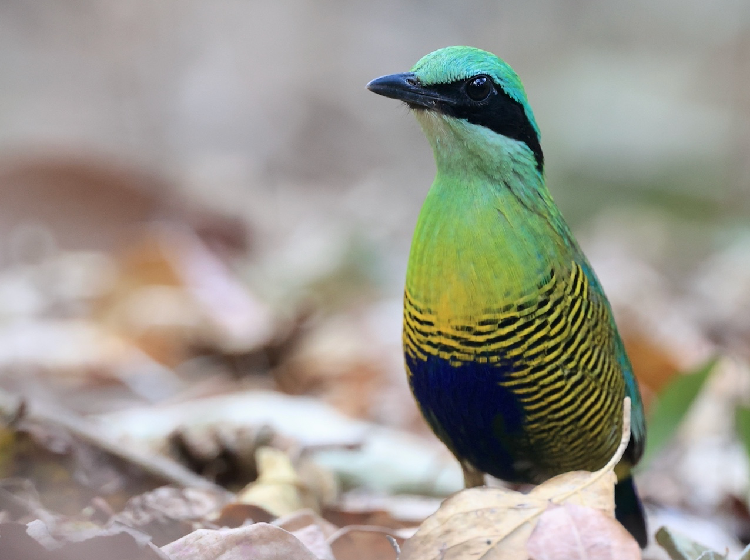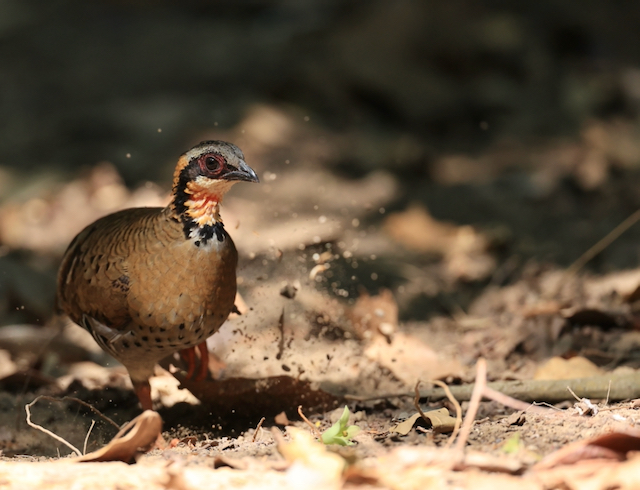
Vietnam is one of the most productive hide-photography countries in Asia, and most photographers still have not noticed. In the lowland forests of Dong Nai Province and on the plateau of Lam Dong, a network of feeding stations brings pittas, partridges, peacock-pheasants, broadbills and a set of laughingthrushes and babblers found nowhere else to within a few metres of the lens, at eye level, in clean light.
Our thirteen-day tour is built entirely around those sites: one to four photographers, two hide sessions a day, and a route that climbs from the lowlands to the highlands so that each day adds a new set of birds.
Vietnam holds around 1,000 bird species, including 20 endemics, most of them concentrated on the southern highlands. Several of them, Collared Laughingthrush, Vietnamese Cutia, Grey-crowned Crocias and Black-crowned Fulvetta among them, were tick-and-go birds for birdwatchers until local guides built hides at the right stakeouts. Today they are photographed reliably, in season, at close range.
The second layer is the lowlands. Dong Nai's forests hold Bar-bellied and Blue-rumped Pitta, Orange-necked and Green-legged Partridge, Germain's Peacock-Pheasant and Siamese Fireback, all of which come to bait stations, plus four broadbills and a run of kingfishers along the rivers. Between the two regions, the mid-elevation forests of Lam Dong add Red-headed Trogon, Indochinese Green Magpie and the parrotbills.
Nights matter here too. Spot-bellied Eagle Owl, Collared Scops Owl, Oriental Scops Owl, Collared Owlet, Large-tailed Nightjar and Hodgson's Frogmouth are all on the target list, and the guesthouses sit close enough to the sites that an owl session does not cost you the next morning.
December to April is the dry season in the south and the hide season: birds are active, trails are dry, and the plateau mornings are cool and clear. We travel in March, when the wintering thrushes and flycatchers are still present and the resident birds are starting to breed and sing. The May to October rains make the lowland hides unreliable.
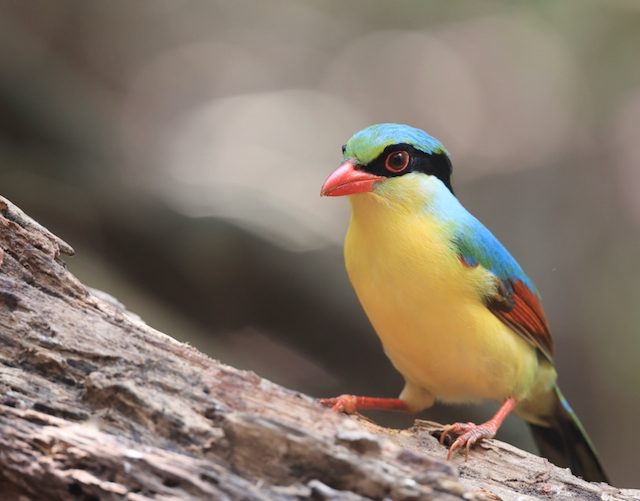
Ho Chi Minh City, then four nights in Dong Nai Province [Cat Tien] for the pittas, partridges, broadbills and kingfishers; then three sites across Lam Dong Province over eight nights, moving up through the mid-elevation forest [Di Linh] to the plateau [Da Lat] for the peacock-pheasant, owls, trogons and the endemic laughingthrushes, cutia and crocias. Departure from Lien Khuong airport. 17 hide sessions across the trip.
US$7,500 per person (2027), single supplement US$700. Includes guiding, ground transport, domestic flights, accommodation, meals, entrance and hide fees. Also scheduled 12-25 March 2028 (US$7,900) and 2029 (US$8,300). Full day-by-day plan on the departure page.
Private departures on other dates between December and April are possible; ask us.
December to April. Our scheduled tour runs 12-25 March.
Bar-bellied Pitta, Germain's Peacock-Pheasant, Siamese Fireback, Orange-necked Partridge, Collared Laughingthrush and Vietnamese Cutia are reliable at the hides in season. Thirty or more species at close range over the thirteen days is normal.
Four at most. Private trips for one or two photographers are easy to arrange in the dry season; solo travellers on a private trip pay a single-participant surcharge.
Almost everything is photographed from hides. A 400-600 mm lens covers the bait stations; many birds come close enough for 300 mm. A tripod or beanbag is essential; a flash is useful for the owl sessions.
Easy. Short walks to the hides, early starts, long sits. The plateau is at around 1,500 m, which nobody notices.
Guiding, ground transport, domestic flights, accommodation, meals, entrance fees and hide fees. Not included: international flights, visa, travel insurance, tips for local guides, personal items.